Wooden Play Kitchen with Lights & Sounds: Setup Tips
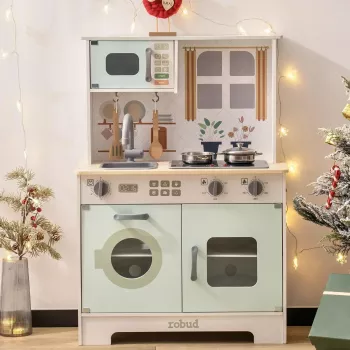
Wooden Play Kitchen Set with Lights & Sounds: A Little Kitchen That Sparks Big Pretend Play
A play kitchen is one of those gifts that doesn’t get “outgrown” after a week—it becomes a daily stop for breakfast orders, snack stands, and imaginative dinner parties. Our Wooden Play Kitchen Set with Lights & Sounds brings extra realism with interactive effects, while keeping the warm, classic feel of a wooden set. Below, our team focuses on what matters for everyday play: safe setup, how to get the most out of the light-and-sound features, and simple ways to build routines and skills through pretend cooking. For more guidance, see 8 Best Wooden Play Kitchen Sets For Toddlers and Kids ….
Why lights and sounds make pretend play easier to start (and stick with)
Some kids jump into pretend play instantly; others want a clear “signal” that a toy is ready. Lights and sounds give that cue, and they do it in a way kids can control. For further reading, see Kids Kitchen Realistic Kitchen Playset Kids Kitchen Playset ….
- Instant “this is real” moments: a button press, a light glow, or a cooking sound helps you avoid having to prompt the story every time.
- Longer play sessions: interactive feedback encourages repeat actions—turning knobs, “checking” food, resetting the scene, and narrating what happens next.
- Great for mixed-age play: younger kids can copy simple cause-and-effect actions, while older kids build full scenarios (menus, timing, taking orders).
- A natural stage for social skills: taking turns, offering choices, and practicing polite phrases (“Would you like soup or pasta?”) happens organically at a kitchen counter.
What makes a wooden play kitchen a smart choice for the playroom
Wooden play kitchens tend to earn their keep because they feel more like a piece of play furniture than a single-purpose toy.
- A steady, furniture-like feel: stability matters when kids are opening doors, turning knobs, and moving play food back and forth.
- A timeless look that blends in: a wood-style set can live in a shared space without feeling like visual clutter.
- Built for repeat play: kitchens are routine-friendly—kids revisit them daily the way they revisit a favorite book bin.
- Skill-building through play: you’ll naturally hear language practice (naming foods, describing steps), early math (counting items, “measuring”), and sequencing (first/next/last).
For more on why this kind of open-ended play matters, you can also explore guidance from the NAEYC and the American Academy of Pediatrics.
Before buying: the 5 checks that matter most for everyday use
When a kitchen is easy to use and easy to reset, it gets played with more often. These are the checks that tend to make the biggest difference at home.
- Age fit: match the set to how your child plays right now—simple open/close and button-press fun for younger kids, deeper role-play stations for older kids.
- Interactive features placement: controls should be easy to reach and intuitive so you’re not needed as the “on” switch every time.
- Stability and play posture: the best setups invite standing play with enough room to move items between sink, counter, and “stove.”
- Cleanup-friendly design: smooth surfaces and straightforward compartments make it easier to reset after play (which increases how often it gets used).
- Sound comfort: if your home is sensitive to noise, plan “quiet hours”—many families keep batteries in but set expectations for when sound effects are used.
A quick overview: play zones to encourage richer kitchen stories
Kids tend to play longer when the kitchen feels like it has “places” for a story to move through. Even if your set is compact, you can create these zones by how you place accessories.
| If the child likes… | Set up the kitchen with… | Try this play prompt |
|---|---|---|
| Buttons & switches | Lights/sounds ready, simple accessories | “Can you cook breakfast and tell what you hear?” |
| Sorting and organizing | Baskets for food, a “pantry” area | “Stock the pantry by color or type.” |
| Pretend hosting | Plates/cups, a “menu” card | “Open your café—what’s today’s special?” |
| Copying grown-ups | Apron/chef hat, towel for “cleaning” | “Let’s cook, serve, then reset the kitchen.” |
Setup tips that keep the kitchen in rotation
If you want a practical helper for the post-play crumb sweep in the same area, our Lightweight Canister Vacuum Cleaner is a simple way to keep the “kitchen corner” feeling inviting without turning cleanup into a big production.
Care, batteries, and sound etiquette (so everyone stays happy)
When this kitchen makes the most sense as a gift
FAQ
Do the lights and sounds require batteries, and can they be used without them?
The interactive lights and sounds typically run on batteries. Even without batteries installed, the kitchen still works as a pretend-play set, so you can choose sound-on play or a quieter routine whenever you want.
What age is a wooden play kitchen set best for?
Wooden play kitchens are commonly a great fit from toddler years through early elementary, depending on your child’s height and how they like to play. Younger kids tend to love doors, knobs, and simple sound-and-light actions with supervision, while older kids build longer role-play “restaurant” or “family dinner” stories.
How can the kitchen be kept tidy with lots of accessories?
Use one dedicated accessory bin, rotate items weekly, and keep only a few favorites on the counter at a time. A quick “closing time” reset—everything in the bin and a fast wipe—helps keep the kitchen ready for the next play session.








Leave a comment