Modern Wooden Cat Tree Tower: Condo, Nest & Scratch Posts
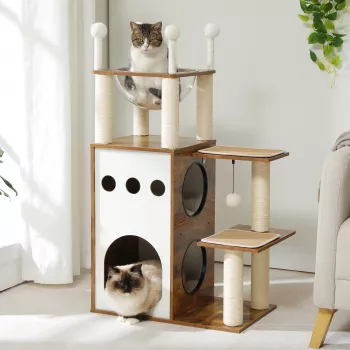
Modern Wooden Cat Tree Tower: A Clean-Lined Home Base for Climbing, Hiding, and Napping
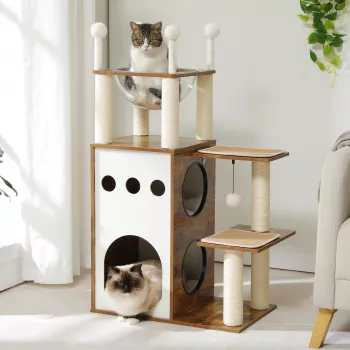
A cat tree should do more than fill a corner—it should give your cat a daily routine: climb, perch, scratch, retreat, and reset. Our Modern Wooden Cat Tree Tower with 2-Floor Condo, Capsule Nest & Scratching Posts pairs a streamlined, wood-forward look with the spaces cats reliably use: a two-floor condo for quiet time, a capsule-style nest for curled-up naps, and scratching posts that help redirect claws away from furniture. It’s a compact “home within your home” designed to feel intentional in the room while staying irresistible to cats.
What this tower adds to a cat’s day-to-day
Cats thrive on repeatable patterns—small rituals they can do over and over without needing you to run “entertainment” all day. A vertical tower creates those rituals naturally.
- A vertical path that turns idle time into movement: hopping up, stepping down, and choosing new vantage points throughout the day.
- A built-in retreat when your household gets busy: enclosed spaces support decompression and can reduce stress for shy or easily startled cats.
- A dedicated scratch zone: helps protect sofas, bed frames, and rugs by giving claws a consistent, rewarding target.
- Multiple “moods” in one footprint: open perching + enclosed hiding + a nest-like nap spot, so your cat can switch spaces without leaving the tower.
- A modern, furniture-like presence: a cleaner look that blends with minimalist, Scandinavian, or contemporary interiors—less plush clutter, more clean lines.
Quick layout guide: spaces cats use and why they matter
| Feature | Best for | Behavior it supports | Where it fits at home |
|---|---|---|---|
| 2-floor condo | Cats that like privacy, multi-cat homes | Hiding, resting, decompressing | Quieter corner of the living room or bedroom |
| Capsule nest | Nap-lovers, curlers, seniors | Deep sleep, warmth-seeking, security | Near a window or in a cozy nook |
| Scratching posts | Active scratchers, furniture-targeters | Claw maintenance, stretching, scent-marking | Near a sofa edge or along a common route |
| Tower profile | Small to mid spaces | Vertical exploration without taking over the room | Apartment corners, beside a bookshelf, near a window |
Who this style of cat tree is made for
- Indoor cats that need enrichment: vertical territory helps replace “outside” stimulation with safer, repeatable routines.
- Cats that alternate between social and solitary: open areas support hanging out nearby; the condo supports boundaries when your cat wants distance.
- Homes that prefer a cleaner aesthetic: a wooden tower can feel like a real furnishing instead of a temporary pet accessory.
- New-cat transitions: an enclosed condo and a defined scratching zone can help establish a predictable, calming base area.
- Multi-cat dynamics: more than one usable zone reduces competition and gives cats options to pass each other without conflict.
For broader behavior context, we also like the practical, cat-centered guidance from the American Association of Feline Practitioners (AAFP) Feline Behavior Guidelines.
Placement that makes the tower instantly popular
You can buy a great cat tree and still end up with a “decorative” item if it’s placed where your cat has no reason to go. A few small placement choices usually make the difference.
- Put it where life happens: cats follow routines, so a tower near your living area gets more use than one hidden away.
- Use the “window rule”: placing it near a window turns perching into a daily activity—watching birds, people, and light changes.
- Anchor it to a traffic lane: near a hallway opening or beside a couch, it becomes a checkpoint spot.
- Keep the condo calmer: aim the condo opening away from loud speakers, busy doorways, or high-energy play zones.
- Pair it with a scratch-friendly cue: a small sprinkle of catnip or a favorite toy nearby can teach “scratch here” from day one.
Getting cats to use the condo, nest, and posts (without a battle of wills)
Your cat will “vote” with repetition: whatever works once tends to become the habit. The goal is to make the first few experiences on the tower feel natural and rewarding.
If scratching is the main challenge, the straightforward breakdown from International Cat Care is worth a read—especially the part about scratching as both claw care and communication.
Care routines that keep it looking sharp
To make weekly cleanup fast, our team often pairs a cat tower with a practical home tool like our Lightweight Canister Vacuum Cleaner—especially if your cat treats the nest like their personal shedding studio.
A simple match-up: cat personality to tower features
FAQ
Is a condo-style cat tree good for multi-cat homes?
Yes—separate zones (condo + nest + open perches) reduce competition by giving each cat more than one acceptable place to land. Place the tower in a shared area, and keep at least one other scratch spot elsewhere so no cat can “guard” the only scratching station.
How do you get a cat to stop scratching the couch and use the posts instead?
Move the tower right next to the couch at first, reward every scratch on the posts, and use a little catnip or familiar scent to make the posts more interesting than the upholstery. While the habit forms, make the couch temporarily less satisfying with a cover or deterrent texture.
Where should a cat tree go for maximum use?
Put it where your cat already spends time: near a window, in the main living space, or along a common route like a hallway opening. Aim the condo entrance toward a calmer direction so the hideaway stays a reliable “quiet zone,” not a high-traffic stress point.









Leave a comment